How to Build a Self-Improving AI Harness: Six Foundations
When everyone has the same AI models, your edge is how fast you turn mistakes and learnings into better business processes.
The system you build around the model to do that is called a harness. If yours isn't capturing failures and improving daily, you're behind the curve. Your competitors can rent the same models, but they can't rent everything your business has learned from its own mistakes.
The video gives you a framework for bootstrapping a self-improving harness from scratch, and the guide below walks your agent through all of it.
Watch the video
Here's the full video on YouTube if you'd rather watch.
The Six Foundations
Title companies were running human-powered self-improvement loops decades before AI arrived. People search the records, an underwriter checks their work, and every claim that slips through teaches the whole business something.
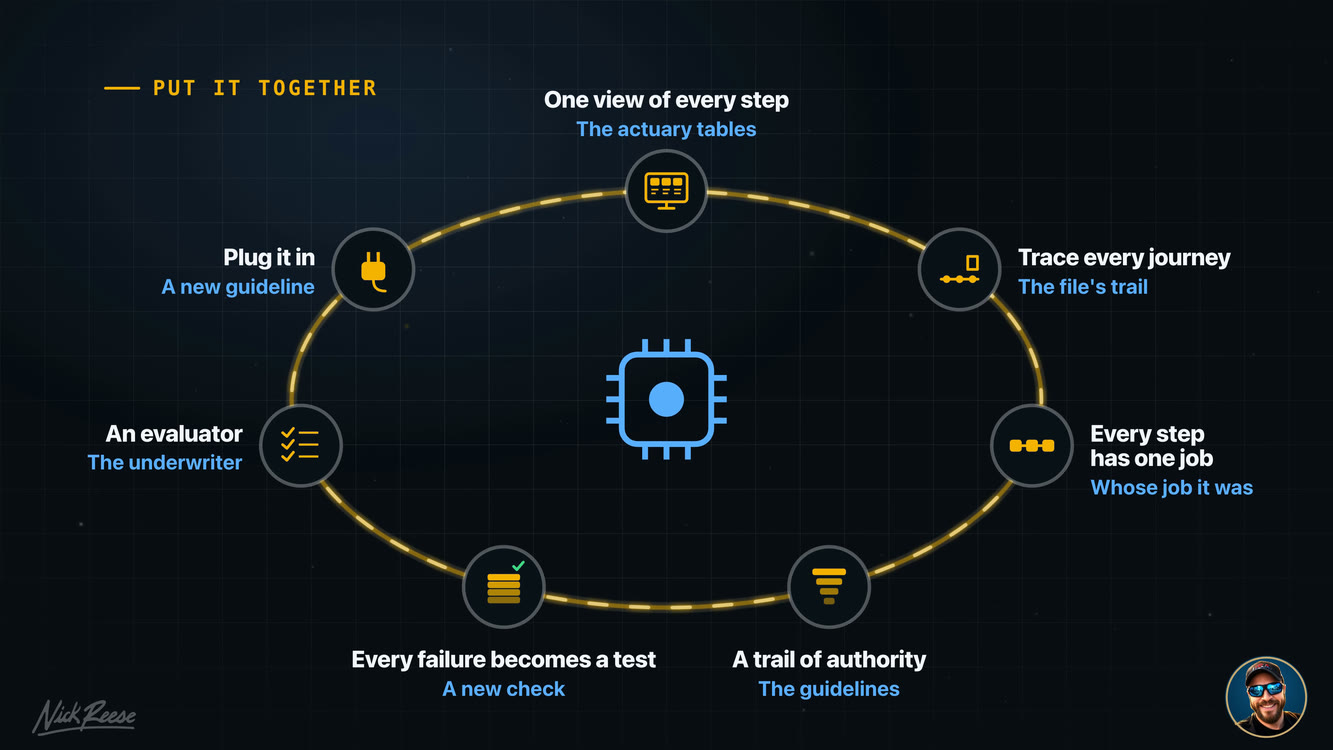
Their loop stood on six foundations. Each one maps onto your harness:
- Every step has one job. At the title company, the person who read the records wasn't the one who approved them. Breaking each step into one job makes it testable.
- Trace every journey. Every file left a trail. Record what goes into each step and what comes out, for every case, so you can rebuild any run.
- A trail of authority. The guidelines always had the final say. Document your product decisions and use them as authority for every agent decision: the product goal first, then the owner's decisions, then the tests and rubrics, and the agent's own decisions last.
- An evaluator. The underwriter was a second set of eyes. In your harness, that's a model that grades each step's work against a rubric. The model doing the auditing shouldn't be the model doing the work.
- One view of every step. Every claim fed the actuary tables. See the timing, the testing and the flows at every step, and what changed, why and how.
- Every failure becomes a test. Every miss became a new check. Save each failure as a test case, replay the step with something different (another model, a decision model, a classifier trained on your own data, new prompts or tools), let the evaluator grade them and plug in the winner.
Put those six together and you have the title company's loop, running on agents. Every failure leaves the business with a better system.
Where to Start
You don't need all of this on day one. Focus on great logging, clear authority and a super agent that you know you'll refactor. Let a state-of-the-art model discover the problem space. As you learn the shape of the work, break it into stages and make sure you have all six foundations.
When you move from a super agent to workflows, write your own, in Rust or TypeScript. If you're using TypeScript, grab Mastra, and know you'll outgrow it.
The Guide
The guide covers everything in the video. Give it to your AI along with this prompt:
A prompt you can use
Audit my logs and my chat conversations against the six foundations of a self-improving harness: every step has one job, trace every journey, a trail of authority, an evaluator, one view of every step, and every failure becomes a test. Then bootstrap a series of flows that build the six foundations.
Download the PDF Markdown for your AI
Always on your team,